
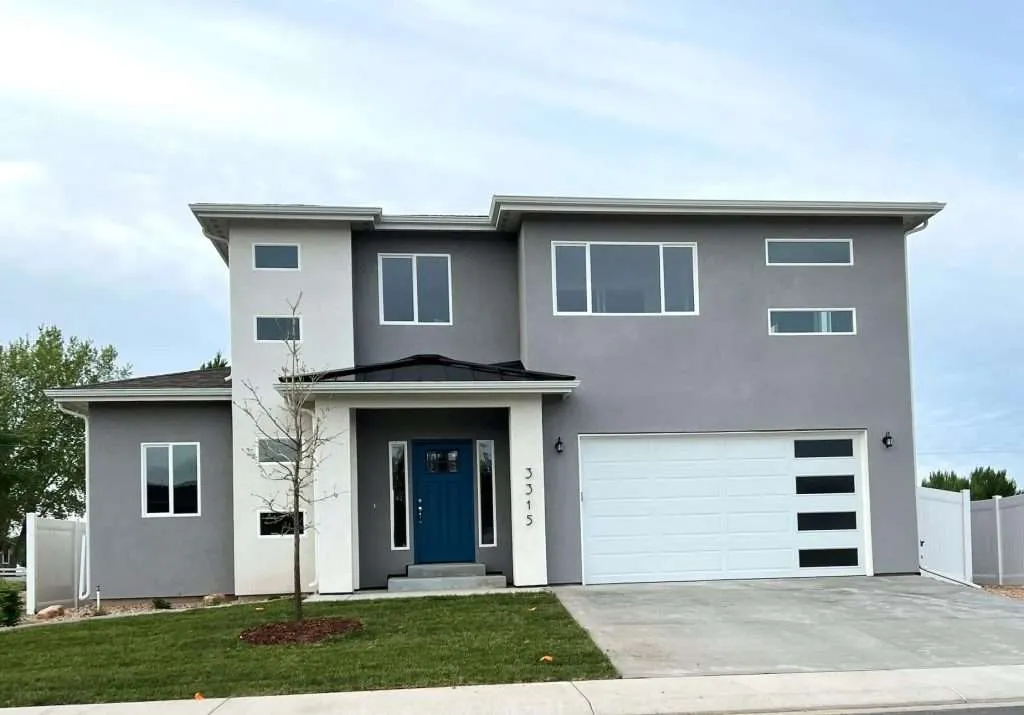
The cost to build a custom home in Grand Junction is the first question almost everyone asks, and the honest answer is that nobody can price one from the question alone. What a builder can do is tell you exactly what drives the number, which parts of it you control, and what a real quote requires. That is what this is.
If you want a current figure for a specific plan on a specific lot, ask us for it directly. The rest of this explains what will be in that figure and why two quotes for “the same house” can be far apart.
The market you are building into
Some context first, because build costs are always judged against what finished homes sell for. In July 2026 the median sale price in Mesa County was $428,500 across all homes, new and resale together, according to Bray & Co’s monthly market report. Half of homes sold above that, half below. The same report counted 270 sales, 971 active listings, and a median 66 days on market.
What a new home costs, and why there is no local number for it
Here is something worth knowing before you go looking for it yourself: there is no published median price for a new construction home in Grand Junction. The local market report tracks the median across all sales and tracks new construction separately as building permits, not as prices. So any “median new build price for Grand Junction” you find online is an estimate somebody generated, not a record of what new homes actually sold for here.
The closest real figure is national. The median price of a new house sold in the United States was $393,800 in July 2026, per the Census Bureau and HUD new residential sales report released that August.
Put those two side by side and the useful point appears. The national new-home median sits below the Mesa County all-homes median. New construction is not automatically the expensive option, and the assumption that building always costs more than buying is not supported by either number. What decides your figure is the five things below, not the category the house falls into.
One more local signal, because it says something about the market rather than about your budget: 381 single-family building permits were pulled in Mesa County through July 2026, down about 7 percent from 410 over the same months of 2025. Permits count homes starting, not homes selling, so read it as the pace of construction rather than as demand.
All of these numbers are snapshots, and they move. They are reference points rather than budgets, and none of them prices a custom home, because a custom home is not a median anything.
Five things that decide the cost to build a custom home in Grand Junction
1. The lot, and what the lot demands
This is the biggest single variable and the one buyers most often leave out of their mental math. Two identical houses on two different lots do not cost the same to build.
- Land price varies enormously across the Grand Valley by location, size and view.
- Site work is the real swing factor: clearing, cut and fill on a slope, retaining walls, an engineered foundation where soils require one, and drainage.
- Utilities to the pad. Water, sewer or septic, power and gas. A lot where services are at the street is a different project from a parcel where they are hundreds of feet away.
- Driveway and access, which on a rural-feeling lot can be a serious line item on its own.
A lot that looks like a bargain and needs heavy site work is not a bargain. Get a soils report and a site evaluation before you buy land, not after. See our guide to building in the Redlands or Monument Ridge for the full checklist.
2. Size, and more importantly shape
Square footage matters, but the shape of the plan matters nearly as much for the same area. A simple rectangular footprint with a straightforward roof costs less per square foot to build than the same square footage broken into wings, bump-outs and multiple roof planes. Corners, angles and roof complexity all cost money.
This is why comparing builders on a price per square foot alone is close to meaningless. The number is an output, not an input, and it moves with the design.
3. Finish level
Two houses with identical plans can differ by a very large amount purely in selections. Cabinetry, countertops, flooring, tile, plumbing fixtures, lighting, windows, doors and exterior materials each span a wide range, and they compound because they run through every room.
This is also the part you have the most direct control over. When a budget needs to come down, it usually comes down here rather than in the structure.
4. Permits, fees and connections
These are not headline numbers but they are real and they are not optional. Depending on whether your parcel is inside the City of Grand Junction or in unincorporated Mesa County, you are looking at building permit and plan review fees, water and sewer connection or tap fees, and possibly impact fees.
Confirm these for your specific parcel with the issuing jurisdiction and the utility providers before you set your budget. They change on their own schedules, and a figure quoted to a neighbor two years ago is not your figure.
5. Timing, financing and how long the build takes
Material and labor pricing move over time, and a construction loan carries interest during the build. A longer build costs more than a shorter one for reasons that have nothing to do with the house itself. Ask any builder how they handle price changes between contract and completion, and get the answer in writing.
What is usually not in the number you first hear
When a build price sounds surprisingly low, it is often because some of these sit outside it. Ask about each one explicitly.
- Landscaping, irrigation and sod.
- Fencing.
- Window coverings.
- Appliances, or which appliances.
- The driveway, if it is long.
- Site work beyond an assumed standard lot.
- Utility connection and tap fees.
- Radon mitigation.
- Design and drafting.
How to compare two builder quotes honestly
This is where most people lose money, and it costs nothing to do properly.
- Put the two scopes side by side before the two prices. If one includes landscaping and the other does not, you are not comparing prices, you are comparing lists.
- Ask what the allowances are. An allowance is a placeholder for a selection you have not made yet. Low allowances make a quote look competitive and then reappear later as overages.
- Ask what happens when something is found in the ground. Who carries that risk, and how is it priced?
- Ask how a change order is priced and how long it takes. A real answer is in days.
- Ask who does the site work and whether the builder employs them or hires them out. When excavation and building sit in the same organization, a surprise in the dirt is solved as part of the build rather than argued about between two companies. Ours is handled through our affiliated company High Grade Concrete & Excavation.
A cheaper way to get most of the answer
If the custom number turns out to be higher than you expected, there are two paths that get you a new home for less work and less uncertainty.
Build from an existing plan. A plan that has been built before has known costs, known site requirements and no design phase. Our floor plan library is the starting point, and choosing from it is what separates a semi-custom home from a fully custom one on price.
Buy a home that is already standing or under way. A finished move-in ready home closes on the same schedule as a resale, because the house already exists. Homes still under construction often still have selections open, so early in a build you can get some personalization without the full wait. Both are on homes for sale.
Get a current number for your plan and your lot
Prices move, and any figure published in a blog post is out of date the week after it is written. So we do not publish one here. What we will do is put a current, specific number in front of you for the plan you like on the lot you are considering.
Request current pricing and tell us the plan, the community or the lot, and roughly when you want to be in. Or call 970-255-6520. If you are not that far along yet, the Home Design Quiz takes a few minutes and gets you to a shortlist first.
You can also read how a build runs from first consultation to keys in hand, which is where most of these costs actually appear in order.