
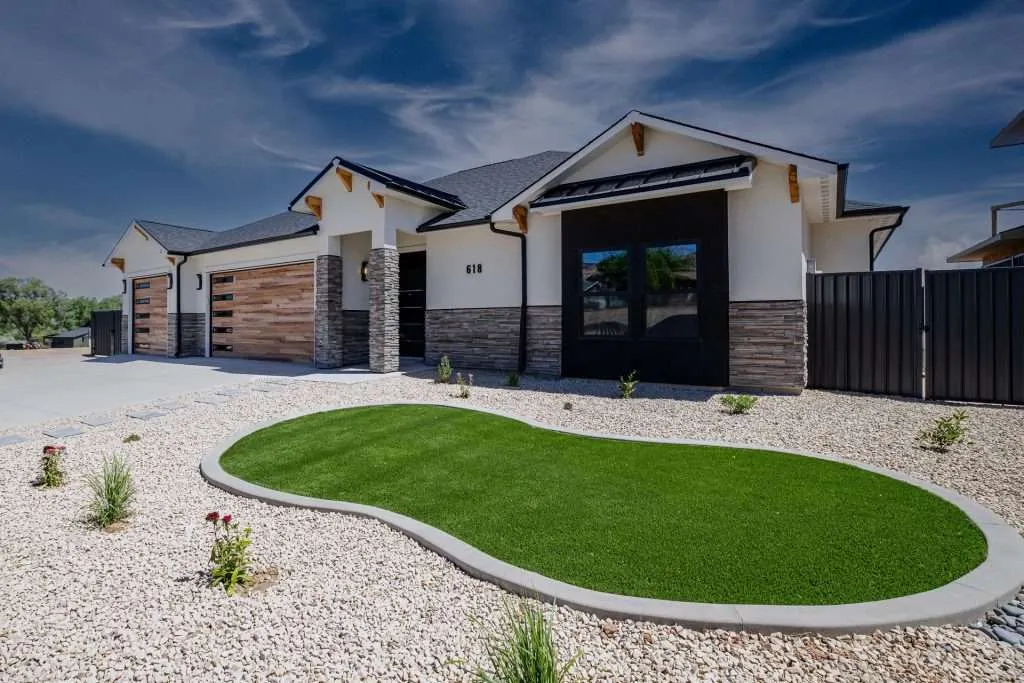
Building in the Redlands is what a lot of Grand Valley buyers want, and it is also where the most decisions get made before anyone draws a plan. The land is not uniform. Two lots a block apart can sit in different jurisdictions, carry different water arrangements, and need very different site work before a foundation goes in.
None of that is a reason to avoid the area. It is a reason to ask a specific set of questions early, while you can still choose a different lot or a different plan. Here is what to check, in the order it matters.
Before building in the Redlands, know which lot you are looking at
“The Redlands” covers a wide stretch west and south of the Colorado River, from established streets near Broadway out toward the Colorado National Monument. Parcels there fall under either the City of Grand Junction or unincorporated Mesa County, and that single fact drives the permitting path, the review timeline, and sometimes the utility connections available to you.
Before you make an offer on land, get the answer in writing from the seller or the county assessor’s record. Ask three things:
- Who issues the building permit for this parcel? City or county. They are separate processes with separate fee schedules.
- What is the zoning and what does it allow? Setbacks, height and accessory buildings vary, and a lot with Monument views often has a slope or drainage constraint attached to the same view.
- Is the parcel in a platted subdivision with covenants? A recorded subdivision comes with rules already answered. Raw land does not.
Water in the Redlands is two separate questions
This is the part that surprises people moving in from outside the valley. Drinking water and irrigation water are not the same system and do not come from the same place.
Domestic water is what comes out of the tap, and most of the Redlands is served by Ute Water. What you need to confirm for a specific lot is whether a service line already reaches it and what a new connection costs, because that answer changes with distance from the main.
Irrigation water is delivered by Redlands Water and Power, which serves roughly 4,500 acres of the Redlands and manages about 6,000 shares of water stock. Shares attach to land, not to people. A lot may come with them and it may not, and that is worth knowing before you plan a lawn, a garden or mature landscaping. Delivery is also seasonal rather than year round: the company’s posted water out date for 2026 is 12 October. Voluntary conservation measures are in effect this season as well.
The practical version: ask the seller whether the lot carries irrigation shares, how many, and confirm it with the company rather than taking it on trust. If it carries none, plan the landscaping around that from the start instead of discovering it in year two.
Sewer or septic, and why it decides more than you would think
Some Redlands parcels connect to the regional sewer system. Others, particularly larger or more outlying lots, are on septic. If the lot is on septic, the soil percolation results and the leach field location shape where the house can physically sit, which in turn narrows which floor plans fit the lot.
This is one of the clearest cases for settling the site question before falling in love with a plan. A plan that needs a wide, shallow footprint may not work on a lot whose buildable area is long and narrow once the septic field is placed.
What the ground itself will ask of you
Redlands lots range from flat and simple to steep and interesting. The interesting ones cost more to prepare, and the cost is real work, not a markup.
- Slope. A view lot usually earns its view from elevation. That can mean cut and fill, retaining walls, an engineered foundation, or a walkout design that turns the slope into a benefit rather than a fight.
- Soils. Parts of the valley carry expansive clays and shale that swell and shrink with moisture. A soils report tells you what foundation the ground requires. Skipping it is how a house ends up with cracked drywall in year three.
- Drainage. Where does water go when it comes off the slope above you in a hard summer rain? That answer belongs in the site plan, not in the first monsoon.
- Radon. This is a Western Colorado reality, not a Redlands one. Mitigation is straightforward when it is designed in and awkward when it is retrofitted.
- Access and utilities to the pad. A long driveway, a power run, or a water line stretched across a big parcel are all line items. On a rural-feeling lot they can be significant ones.
Get a soils report and a site evaluation before you close on land, not after. It is the cheapest information you will buy in the whole project.
If you would rather skip most of that: Monument Ridge Estates
There is a second path through the Redlands that removes almost every question above, and it is worth understanding as a real alternative rather than a lesser one.
Monument Ridge Estates is a platted subdivision in the Redlands, near the Colorado National Monument, with homesites between 0.19 and 0.35 acres and a $500 annual HOA. The lots are already served, already zoned, already reviewed, and the plans that work on them are already known. Select lots carry Monument views.
You are trading acreage for certainty. On a Monument Ridge homesite, the site work is a known quantity and the timeline is not waiting on a percolation test. If what you actually wanted from the Redlands was the setting, the access to the Monument and the neighborhood, rather than a large parcel specifically, this is usually the shorter road to living there.
The full lot map, the plans available in the community, and current pricing all live on the community page. That page is the source of record for what is available today.
Build on land you already own
If you already hold a Redlands parcel, the questions above are your starting checklist rather than a shopping list. We work on owner-supplied lots regularly, and the first step is the same either way: a site evaluation that tells us what the ground requires, and then a plan chosen to fit it.
Site preparation, grading, excavation and foundations are handled in house through our affiliated company High Grade Concrete & Excavation, which matters more on a Redlands lot than on a flat one. What gets found in the dirt reaches the people planning your house immediately, rather than becoming a claim against the build. You can read how that runs on our process page.
A short checklist to take with you
Print this, or take it to the next lot you walk.
- City or county jurisdiction, confirmed in writing.
- Zoning, setbacks and any recorded covenants.
- Domestic water service: is it at the lot, and what does connecting cost?
- Irrigation shares: does the lot carry any, and how many?
- Sewer or septic, and if septic, where the field goes.
- Soils report and foundation recommendation.
- Drainage from uphill parcels.
- Driveway length, power run and utility distances to the building pad.
- Whether the plan you like actually fits the buildable area that is left after all of the above.
Where to start
- Monument Ridge Estates, if you want the Redlands without the land homework.
- Our communities, to compare Monument Ridge with Vista Mesa and River Stone.
- Floor plans, once you know what your lot will carry.
- Build on your lot, if the parcel is already yours.
Not sure which of those you are? The Home Design Quiz takes a few minutes and asks about your timing, your budget and how you actually live, and we come back with the path that fits. Or get in touch and walk a lot with us. Call 970-255-6520.