
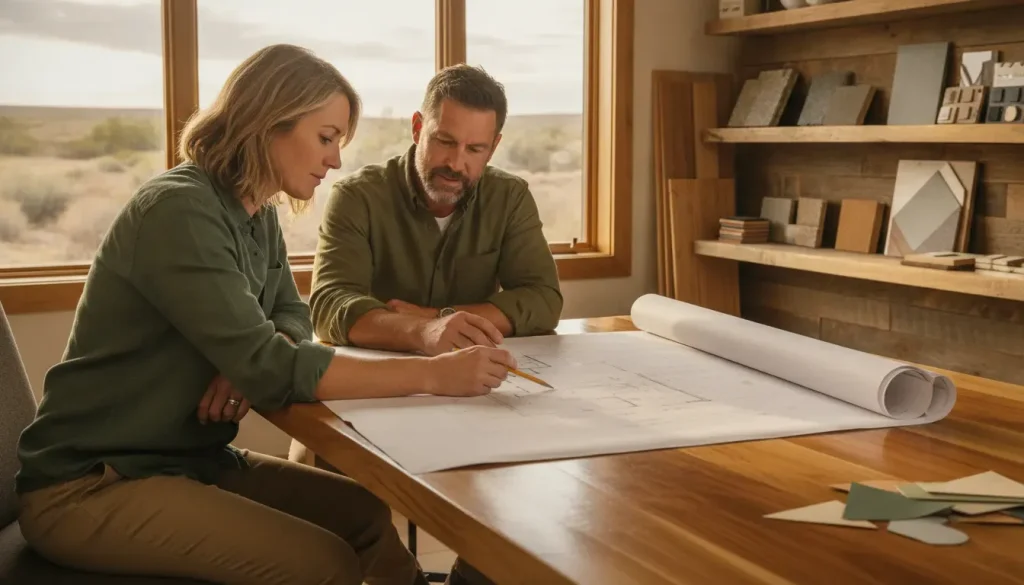
Negotiating a custom home is less about asking for a simple discount. It is about making sure the scope, selections, timing, and site responsibilities are understood before construction begins. In Western Colorado, a proposal can change based on the lot, utilities, excavation, foundation needs, grading, drainage, and the finishes you choose.
Talk with Integrity Homes about your custom home plans and options.
When buyers ask, “can you negotiate with a custom home builder costs,” the practical answer is yes. You can often discuss scope, allowances, upgrades, payment milestones, and change procedures. Costs tied to code, engineering, labor, materials, or site conditions may have less flexibility, so every adjustment should be evaluated and documented in writing.
A clear agreement should distinguish the standard-specification base price from lot-specific adjustments and selected upgrades. That gives you a more useful basis for comparing proposals and deciding where a change creates value. Start by looking closely at what the contract includes, what it leaves open, and which responsibilities belong to the builder or homeowner.
What Can You Negotiate in a Custom Home Contract?
Yes, but negotiation in a custom home project is usually about aligning scope and documenting tradeoffs, not simply asking for a lower total. The most productive questions clarify what the base specification includes, which selections can change, which allowances are flexible, and how a decision affects the schedule or contract. That gives you a more useful comparison than looking at one headline number.
Before signing, review the plans, specifications, proposal, construction contract, and change-order process together. A preliminary quote should reflect both your selections and the conditions of your lot. Integrity Homes’ process addresses plan selection, lot evaluation, preliminary quote development, and timeline planning before the agreement phase. When the base price, lot-specific adjustments, responsibilities, and milestone-based payments are established.
Scope and inclusions
Ask for a clear description of the work included in the base specification. This may cover the plan, standard materials, fixtures, systems, site work, and project responsibilities, but the details matter. Confirm whether each item is included, listed as an allowance, treated as an upgrade, or excluded from the proposal.
- Which plans, room dimensions, finishes, fixtures, and systems are included?
- Are permits, utility connections, delivery, cleanup, and required site work addressed in the scope?
- Which items are excluded and would be handled by the homeowner or another contractor?
- What changes to the layout or specifications can be considered before the contract is finalized?
Allowances, selections, and responsibilities
Allowances deserve a specific conversation. Ask what each allowance covers, how selections above or below that amount are handled, and whether installation labor is included. A finish that appears similar on a selection sheet can have different material, labor, delivery, or schedule implications. Design consultation can address space planning, materials, colors, finishes, energy-efficient systems, smart-home features, and other upgrades, so use that stage to connect preferences with the working budget.
Responsibilities should be equally clear. On a Western Colorado lot, utilities, development requirements, excavation, foundation needs, grading, drainage, and other site conditions can affect both scope and contract value. Ask who evaluates each condition, who obtains approvals, and how an unknown condition will be documented if it changes the work. High Grade Concrete & Excavation supports related excavation, foundation, utility, grading, and drainage work through its regional affiliation with Integrity Homes.
Documentation and change procedures
Any negotiated adjustment should appear in writing. Confirm the revised scope, materials, allowance, labor, schedule impact, payment milestone, and approval date before work proceeds. A visible record helps everyone work from the same information. Integrity Homes uses Buildertrend for document management, selection tracking, budget visibility, change-order management, messaging, and progress updates. The goal is a contract that reflects the home you intend to build, with fewer assumptions left between the lines.
Can You Negotiate With a Custom Home Builder? Understand Which Costs Are Flexible
Some parts of a custom home can be adjusted through thoughtful selections and clear scope decisions. Other costs respond to the lot, local requirements, engineering, or the work required to build safely. That distinction matters when you ask, “Can you negotiate with a custom home builder costs?” The most productive conversation is usually not about pressing for an unsupported discount. It is about choosing where to place value, confirming what the base specification includes, and documenting the effect of each change.
Flexible choices may include floor-plan modifications, finishes, appliances, lighting, energy-efficient systems, smart-home features, and other upgrades. Integrity Homes’ design consultation addresses space planning, materials, colors, finishes, and related options. A pre-designed plan can also be personalized, while fully custom and client- or architect-provided plans may support a different level of design flexibility. Each choice should be reviewed as a complete installed scope, including materials, labor, and any schedule effect.
| Cost area | What may be flexible | What may limit flexibility |
|---|---|---|
| Design and layout | Room sizes, configurations, finishes, and selected features can be compared before approval. | Structural design, engineering, plan revisions, and code requirements still need to be resolved. |
| Selections and upgrades | Materials, colors, fixtures, systems, and finish levels can be adjusted to align with priorities. | Availability, installation requirements, lead times, and labor can change the complete cost. |
| Site and lot work | Responsibilities and assumptions can be clarified early in the proposal and agreement. | Utilities, permits, excavation, foundations, grading, drainage, and lot conditions are not simply elective. |
Why the lot can set the limits
For a build in Grand Junction, Mesa County, or another Western Colorado community, the lot may determine more than the home’s appearance. Evaluation can include utilities, development requirements, excavation, foundation needs, grading, drainage, and other site-specific factors. These conditions can affect both scope and contract value. They should be identified before treating a proposal as directly comparable with another builder’s offer. For more on how the lot, the plan, and the finish level each move the number, see what decides the cost to build a custom home in Grand Junction.
Integrity Homes coordinates related site work with High Grade Concrete and Excavation, an affiliated regional business supporting excavation, foundations, utilities, grading, drainage, and related work. That coordination does not make site-driven work discretionary. It helps connect the required work to the overall construction plan so responsibilities and assumptions can be discussed clearly.
A useful negotiation question is: “What would change if we revise this selection. And what would not change because the lot or code requires it?” Ask for the answer in writing, including inclusions, exclusions, allowances, labor, schedule effects, and change-order procedures. The agreement phase establishes the base specification, lot-specific adjustments, responsibilities, and payment milestones. Clear documentation creates scope clarity, which is more dependable than assuming every line item is open to a discount.
How Can You Negotiate Upgrades Without Losing Cost Control?
When buyers ask. “can you negotiate with a custom home builder costs,” the most useful answer is to negotiate clarity and tradeoffs rather than assume every upgrade comes with a discount. A selection affects more than the visible product. The complete installed cost may include the material, labor, preparation, delivery, installation, and any related changes to the plan or schedule. A lower-cost fixture may still require different rough-ins, trim, or installation work.
Use the following process to keep design flexibility connected to the contract value.
- Define the complete installed cost. Ask for the full effect of an upgrade, not only the product price. For example, changing a countertop, flooring material, window package, appliance, or lighting plan may affect labor, electrical work, cabinetry, finish details, delivery, or disposal. Request that the proposal identify what is included in the material and what is included in installation. This makes it easier to compare a standard specification with an upgraded selection without overlooking the work required to install it.
- Clarify the allowance and the selection. An allowance is not the same as a final product choice. Ask what the allowance covers, whether it includes material and labor, and what happens if the selected item exceeds or falls below that amount. Also ask whether a proposed upgrade changes another part of the scope. The agreement phase should make the standard-specification base price, lot-specific adjustments, responsibilities, and payment milestones clear. Review those items together instead of evaluating an upgrade in isolation.
- Consider lead time before approving the change. Some selections can be made early with little effect on the sequence of work. Others require earlier ordering or coordination with framing, electrical, plumbing, cabinetry, or finish installation. A selection that arrives late can narrow available options or affect the schedule. Discuss lead time during design consultation and identify decision deadlines before work reaches the affected milestone. Integrity Homes develops timelines with seasonal factors in mind, so timing belongs in the cost conversation from the beginning.
- Make important selections early. Early decisions give the builder and buyer time to confirm dimensions, compatibility, availability, and installation requirements. They also create a clearer baseline for comparing alternates. Integrity Homes’ design consultation covers space planning, materials, colors, finishes, energy-efficient systems, smart-home features, and other upgrades. The Integrity Homes building process shows how selections fit within the broader sequence of planning, agreement, design, and construction.
- Put every approved change in writing. Do not rely on a conversation, text message, or verbal understanding for a scope change. A written change order should identify the revised item, the change in material and labor, any schedule effect, and the approval required before work proceeds. Buildertrend supports selection tracking, budget tracking, schedule visibility, document management, and change-order management. Reviewing those records with the construction contract helps preserve cost control while still allowing the home to reflect the buyer’s priorities.
The strongest negotiation is a documented decision: what changes, what stays included, when the decision is needed, and how the change affects the agreement. That approach gives buyers room to personalize a Western Colorado home without treating unknown costs as guaranteed savings.
When Is the Best Time to Discuss Custom Home Costs?
The best time to discuss custom home costs is before design decisions become commitments. Early conversations give you and the builder time to compare the plan, lot, selections, responsibilities. And schedule as one project rather than treating each cost question as a late adjustment.
Start during the pre-building phase
Before finalizing a plan, evaluate the lot and identify the conditions that may shape the work. In Western Colorado, that can include utility connections, development requirements, excavation, foundation needs, grading, drainage, and other site-specific factors. A preliminary quote should reflect both your selections and the known site factors, while the timeline should account for seasonal conditions. This is also the right stage to ask which items belong in the standard specification, which allowances can be adjusted, and which responsibilities remain with you.
For build-on-your-lot projects, site work deserves an especially early conversation. Integrity Homes coordinates excavation, foundations, utilities, grading, drainage, and related work with High Grade Concrete & Excavation. Understanding those requirements before you compare proposals can help you distinguish a real scope difference from a number that simply leaves work out.
Review the proposal before selections become deadlines
Once the preliminary scope is clear, use the proposal and agreement review to confirm the standard-specification base price, lot-specific adjustments, responsibilities, and milestone-based payments. Ask for written clarification on anything that is assumed rather than listed. This is a more productive way to approach the question. “Can you negotiate with a custom home builder costs?” The practical answer is that you may be able to adjust scope. Selections, allowances, or timing, but those tradeoffs should be documented instead of treated as an expected discount.
A design consultation is the next important checkpoint. Space planning, materials, colors, finishes, energy-efficient systems, smart-home features, and other upgrades can be evaluated together. Decide which choices matter most, then ask how each change affects the complete installed scope and schedule. You can review the Integrity Homes building process to understand how selections and milestones fit together.
Do not wait until construction is underway
Selection deadlines exist because late changes can narrow material availability, labor coordination, and installation options. A change may also require a written change order or affect work that has already been scheduled. Buildertrend supports document management, selection tracking, schedule visibility, budget tracking, change-order management, messaging, and daily progress photos, making it easier to keep decisions visible. It cannot remove the practical limits created by completed work or an approaching milestone.
Discuss priorities early, record decisions clearly, and revisit open items before their deadlines. That approach keeps cost conversations focused on informed choices and a workable plan.
How Should You Compare Two Custom Home Proposals?
Start by making the proposals comparable. A lower stated price does not necessarily represent a lower project cost if one proposal leaves out site work. Finishes, appliances, utility connections, or other responsibilities that the other builder has included. Ask each builder to describe the same plan, finish level, lot assumptions, and project scope in writing.
First, separate the base specification from optional selections. Review the plans and specifications line by line. Identify what is included in the base price, what is represented by an allowance, and what will be priced later. Compare the same items, such as flooring, cabinets, countertops, lighting, plumbing fixtures, heating and cooling systems, energy-efficient features, and smart-home options. If one proposal uses an allowance and the other names a specific product or finish, those figures are not directly equivalent.
Next, examine the lot assumptions. In Western Colorado, utilities, development requirements, excavation, foundation needs, grading, drainage, and other site conditions can change the scope. Confirm who is responsible for evaluating and coordinating each item. High Grade Concrete and Excavation, an affiliated regional operation, supports Integrity Homes with excavation, foundations, utilities, grading, drainage, and related site work. The important comparison is not simply whether site work appears as a line item, but whether the same site responsibilities and assumptions are being compared.
Also review the schedule and the process for changes. A proposal should make clear how selections are approved, when decisions are due, and how a change affects the contract, schedule, or payment milestones. Buildertrend can support document management, selection tracking, schedule visibility, budget tracking, and change-order management, but the contract and written change-order process remain the controlling documents.
Use this checklist when comparing proposals:
- Plans and scope: Are the floor plan, square footage, specifications, and included features the same?
- Selections: Are materials and finishes identified, or are broad allowances being used?
- Site work: Are utilities, excavation, foundations, grading, drainage, permits, and development requirements addressed?
- Responsibilities: Who supplies plans, completes approvals, coordinates subcontractors, and handles each site-related task?
- Changes: Is there a written process showing how revisions affect cost and timing?
- Schedule and payments: Are milestones, selection deadlines, and seasonal considerations explained?
For broader context before reviewing builder proposals, read this guide to new home costs and financing. The goal is not to find the proposal with the smallest headline number. It is to understand the complete scope, identify legitimate choices, and compare documented obligations on equal terms.
What Is Integrity Homes Flexible On, and What Stays Tied to the Work?
At Integrity Homes, flexibility starts with understanding how you want to live in the home. The company offers pre-designed plans that can be personalized, along with fully custom plans and client- or architect-provided plans. That gives homeowners room to shape the layout, room sizes, configurations, finishes, and features around real priorities instead of treating the base plan as the final answer.
During design consultation, the conversation can include space planning, materials, colors, finishes, energy-efficient systems, smart-home features, and other upgrades. You can also discuss which selections matter most, where a simpler specification may serve the home well, and how a change could affect the scope, schedule, or contract. The useful question is not simply, “Can this cost change?” It is, “What is the complete effect of this choice, and how will it be documented?”
What can be shaped around your priorities?
- Personalized design: Adjust the plan, room relationships, circulation, and usable space to fit your household.
- Selections: Review materials, colors, finishes, systems, and smart-home features during the design process.
- Milestones: Clarify when decisions are needed and how selections connect to the construction schedule.
- Documentation: Confirm inclusions, exclusions, changes, and approvals in writing so everyone is working from the same information.
Other parts of the project are tied to the actual work required to build safely and meet applicable requirements. Structural design, permitting, building code, labor, materials, utilities, and required site work are not simply discretionary line items. The lot also matters. Utilities, development requirements, excavation, foundation needs, grading, drainage, and other site conditions can change the scope before construction begins.
For Western Colorado projects, Integrity Homes coordinates related site work with High Grade Concrete and Excavation. An affiliated regional operation supporting excavation, foundations, utilities, grading, drainage, and related work. Those requirements should be evaluated as part of the lot and project, not treated as an arbitrary amount to remove from a proposal.
The agreement phase establishes the construction contract, standard-specification base price, lot-specific adjustments, responsibilities, and milestone-based payments. Integrity Homes also uses Buildertrend for document management, selection tracking, schedule visibility, budget tracking, change-order management, messaging, and progress photos. That structure supports a practical approach to cost discussions. You may be able to shape the scope and tradeoffs, but the final contract should reflect the work the home and lot actually require.
Contact Integrity Homes to discuss your design priorities, lot conditions, and project scope.
Frequently Asked Questions
Can you negotiate with a custom home builder?
Yes, but the most productive negotiation focuses on scope and documented tradeoffs. Ask what is included in the base specification, which selections or allowances can change, and how revisions affect the schedule and contract. Site conditions, code requirements, utilities, and required work may not be discretionary.
How much can you realistically negotiate off a house?
There is no universal amount. A builder may be able to adjust the scope, finish level, plan details, or timing, but reducing the contract value usually means changing what is included. Compare complete proposals with the same assumptions rather than expecting an automatic discount.
What percentage does a custom home builder charge?
There is no single percentage that applies to every custom project. Builder costs depend on the plans, specifications, site conditions, responsibilities, and contract structure. Request a written breakdown of the base price, lot-specific adjustments, selections, allowances, and payment milestones.
What should you not say to a builder?
Avoid vague demands such as asking for the lowest possible price without defining the home you want. Instead, identify your priorities, ask what each option includes, and discuss tradeoffs openly. Do not rely on verbal promises. Confirm selections, responsibilities, schedule effects, and approved changes in writing.
Do custom homes take longer to build?
They can, especially when the project includes extensive design decisions, plan revisions, unusual site work, or late selections. Discuss the timeline during pre-building, including lot evaluation, approvals, selection deadlines, and seasonal considerations. Early decisions give the team more room to coordinate the work.
Contact Integrity Homes About Your Custom Home Plans
Clear conversations about your lot, selections, scope, and budget can help you understand which decisions are flexible and which are shaped by site conditions or required work. If you are planning a custom or semi-custom home in Western Colorado, contact Integrity Homes to discuss your plans and next steps.